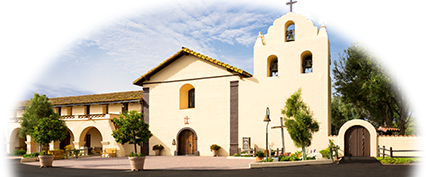

In order to acculturate the Chumash of the Santa Ynez valley into the Spanish way of life, and to serve as a link between the Missions of Santa Barbara and La Purisima Concepción in Lompoc, Mission Santa Inés was established in 1804. While still in its formative years, the Mission was devastated by the great earthquake of 1812. The Mission continued to rebuild and repair, and actually became very prosperous during the first part of the 19th century, when the Chumash population was at its highest. The Mission acreage produced plentiful harvests, and its livestock numbered in the thousands. Mission Santa Inés also became linked to one of the early Anglo settlers in California.
After Mexican Independence from Spain in 1821, secularization caused the departure of the Spanish Missionaries, most of the Chumash neophytes, and the decline of the Mission. During this period the first college seminary was temporarily established at Mission Santa Inés in 1844. The Mission would have fallen into complete ruin were it not for the arrival of the Donahue family in 1882 and Fr. Alexander Buckler in 1904. Fr. Buckler began the repair of the Mission building and enlisted the talents of his niece Mamie Goulet to restore the art and vestment collections left at the Mission. The Capuchin Franciscan Friars from Ireland arrived in 1924 after the retirement of Fr. Buckler. They continued the restoration of the Mission buildings, gardens, and established the Mission museum.
Today the friars continue to restore and preserve the "Mission of the Passes" to serve the greater community. Mission Santa Inés is proud and honored to be the guardian of a rich collection of paintings, statuary, vestments, manuscripts, and artifacts.
The first Mission founded by the Franciscan Padre Junipero Serra was San Diego de Alcala in July 1769. Serra along with the Spanish military opened alta or upper California to settlements. The Spanish missionary effort was to educate and convert the Native Americans (Indians) to Spanish culture which included Christianity. The historian Maynard Geiger stated "This was to be a cooperative effort, imperial in origin, protected in purpose but primarily spiritual in execution."
The Chumash populated a wide area - from Santa Paula to San Luis Obispo. They had a diversified and interdependent economy based on their many talents and craftsmanship. The Chumash developed an excellent astronomical system, which was on a par with Europe in terms of accuracy. Their small, well organized villages, called rancherias by the Spanish-speaking settlers, were made up of many large huts built from poles of interwoven reeds. The Indians gathered and leached acorns, and they also harvested nuts, seeds, and berries. They were skilled fishermen and enjoyed a variety of sea food. They also hunted animals. Although their only tool was flint, the resourceful Chumash created well-constructed sea-going plank canoes.
The founding of a Mission between La Purisima and Santa Barbara had been considered by the Missionary Franciscan fathers for several years. An inland Mission, north of Santa Barbara, would solidify their work in the area. They would be able to take advantage of the Chumash Indians' already favorable disposition to being converted to Christianity. In addition, the militant Indian tribe, the Tulares, lived to the northeast, just beyond the region controlled by the Chumash. A Mission in the Santa Ynez Valley would secure the region and create a buffer zone.
After completing the initial coastal chain of Missions to the north, Father Lasuen directed Father Estevan Tápis of Mission Santa Barbara to accompany Captain Felipe de Goycoechea to survey possible Mission sites northeast of the coastal mountains. In the fall of 1798, the expedition surveyed the Calahuasa rancheria (presently the Santa Ynez Indian Reservation) and another Chumash site called Alajlapu (presently Solvang). Father Tápis reported that there were 325 dwellings at 14 sites at Calahuasa and Father Lasuen reported the findings to Governor Diego Borica. In turn, the Spanish viceroy, Iturrigaray approved Calahuasa as a suitable site for a new Mission.
It would be 6 years before the Franciscans could establish their new Mission. The governor died, so approval was then needed from his successor, Jose de Arrillaga, in Baja California. Unfamiliar with the area, Governor Arrillaga wrote to Father Lasuen in April 1803 concerning the number of guards that would be needed for the new Mission. By the time the letter made its way to Santa Barbara, Father Lasuen had died. Father Estevan Tápis was now Presidente of the Missions. He responded to Arrillaga's letter, detailing the number of Indians in the area and the activities of a small group of Indian outlaws who had been committing murders throughout the region. In September, the Father Guardian of the Franciscan order came from Mexico to survey the site and determined that a guard of 6 men would be sufficient to protect the Mission.
The cemetery is located behind the Mission bell-tower. The first entry in the burial register is dated January 23, 1805. |
New buildings were constructed in 1807 and in 1810 five double houses were built for the soldiers and their families, plus a storehouse and the guardhouse.
In 1812, the population of Chumash at the Mission reaches 718, the highest number throughout the Mission Era. These Chumash included those from Mission Santa Barbara and La Purisima Concepción, who had come to the new Mission to help train the local population.
Changes in the political air soon had their effect on Mission life. After the beginning of the Mexican War of Independence against Spain in 1810, financial support to the missions ceased. The Missions were required to become self-sustaining. Because the soldiers were no longer receiving their salaries and the annual ship from San Blas carrying provisions for the soldiers and their families was also cancelled, the officers at the Presidio made greater demands on the Missions to supply food and clothing to the soldiers and their families. In return, the Missions received IOU receipts.
For safety, a temporary church was erected outside the quadrangle area. Reconstruction of the damaged buildings continued over the next few years. A new and larger church was built of adobe and brick and facing east. It measured 140 feet long, 25 feet wide and 30 feet high, with heavily buttressed walls 5 feet thick. Heavy pine timbers brought from the San Rafael Mountains supported its ceiling and re-tiled roof. The ceiling height was lowered on the residence of the friars, and the flat roof was replaced with a gabled roof covered with tiles. A new belfry was constructed at this time. These buildings, which were dedicated on July 4 1817, still remain today.
The lavenderia (laundry), where Indian women washed their clothes, is preserved today on the Mission grounds. |
The Mission attempted to increase its income by selling the hides and tallow from cattle for basic domestic materials and money to pay the Chumash for their labor. This trade was considered illegal by the Spanish government in Mexico which restricted trade to only approved Spanish traders.
Alleged to originally have come from Boston, Massachusetts, Chapman sailed to Hawaii where he became an unwilling crew member aboard a ship captained by the Argentine privateer Hippolyte de Bouchard. Bouchard raided the Spanish settlements along the California coast as far north as Monterey. In 1818, Chapman was captured during a raid of the Ortega Ranch in Refugio Canyon. The Bostonian told a story of being captured and forced into labor aboard the ship. In an interview with Fr. Uria, Chapman claimed to know how to build a fulling mill. In 1820, Chapman was paroled to the supervision of Fr. Uria at Mission Santa Inés.
The fulling mill was built in 1821 about 1 mile from the Mission quadrangle next to the grinding mill.
In June 1822 Chapman was baptized Juan José Chapman at Mission San Buenaventura in Ventura, and in November he married Maria Guadalupe Ortega. The couple moved to Los Angeles where Chapman planted vineyards. Later he built the first ship in southern California. He retired to his land grant - Rancho San Pedro. He is buried in Mission Santa Barbara cemetery.
This was situation when a La Purisima Chumash visited Mission Santa Inés. During a verbal confrontation with a sergeant at the Mission, the Chumash was seized and whipped. The mounting frustration of both the Chumash and the soldiers reached its peak with the whipping and the revolt of 1824 began.
At Mission Santa Inés the revolt lasted less than a week. Chumash from La Purisima joined with the Mission Chumash and fired upon the soldiers with bows and arrows. The soldiers set fire to the Chumash homes and when the Church caught fire, the Chumash stopped the assault. None of the Mission friars were ever in danger because the Chumash respected and had a great affection for them. The revolt was against the soldiers. The next day some soldiers from the Presidio in Santa Barbara arrived to assist the Mission soldiers.
Father Uria was taken by the soldiers to Mission Santa Barbara and later he was reassigned to Mission San Luis Obispo. Mission La Purisima was not restored and the most of the Chumash left.
The revolt continued at Mission Santa Barbara, long after the conflict at Mission Santa Inés ended.
Growing enmity between the new administrators and the Chumash resulted in most of the Chumash leaving the Mission and the final decline of the Missions.
The first Bishop of Alta California Francisco Garcia Diego, OFM, directed Frs. José Jimeno and Juan Moreno to contact Micheltorena for permission to build a seminary in the remains of the quadrangle of Mission Santa Inés. Micheltorena not only gave permission, he also donated 35,000 acres and established an annual annuity of $500 for its maintenance.
In the Seminary's constitution, there is a provision for the education of the young men of the landowners. The wealthy landowners would pay tuition and enough money was set aside for the less fortunate. In 1844 the College of Our Lady de Refugio was erected.
Micheltorena's rule ended abruptly in 1845 when the local landowners who had been evicted successfully lobbied the governor in Monterey, Pio Pico for the return of the Mission lands. Pico then illegally rented them out. The seminary for Franciscans was relocated 1.5 miles east of the Mission in 1846 and there it continued until 1850. In 1852, under the direction of Rt. Rev. José Sadoc Alemany, O.P., Bishop of Monterey, the seminary was re-commissioned to serve as a diocesan college and seminary and re-named Our Lady of Guadalupe. It was also known as College Ranch and provided education for the sons of local ranchers.
A decree signed by President Abraham Lincoln on May 24, 1862 formally returned the Missions to the Catholic Church with possession given to the Bishop of Monterey.
![]() |
This photo of ruins at Mission Santa Inés
may date from as early as 1865. SANTA BARBARA MISSION ARCHIVE-LIBRARY |
Supervision of the college seminary was transferred to the Christian Brothers from 1877-1881. The institution was closed and the Bishop sold off 20,000 acres. Some of the area became the town of Santa Ynez.
The Donohue family who resided in Gilroy, CA was invited by Fr. Michael Lynch to live and work at the Mission in 1884. Fr. Lynch resided at the college but was directed to move into the Mission with Frs. Farrelly and Lack, and supervise repairs. Mr. Donohue a carpenter, stone mason and blacksmith is credited with making the first improvements to the Mission buildings since the end of the Mission Era. Often financing the repairs, Mr. Donohue and his 4 sons improved the walls and floors, and built a large sala or living room for the priests. In 1898, the Donohue family moved from the Mission to their ranch located about ¼ mile from the Mission.
Father Alexander Buckler SANTA INÉS MISSION ARCHIVE. |
| The expansive garden behind the Mission is a lovely surprise for many visitors. Dating to the Mission's earliest days, the garden has undergone many changes; it currently retains the formal design of a hedge in the shape of a Celtic cross implemented by the Capuchin Franciscans in 1926. |
![]() |
Fathers Kelleher and O'Leary examine adobe walls during renovation work in 1949. SANTA INÉS MISSION ARCHIVE. |
Full restoration of the Mission began in 1947. When the workman removed the roof from part of the residence, they discovered the outline of several rooms above the arches that had been used by during the Mission Era. The second story was added making the Mission look as it did before the earthquake of 1812. Extensive repairs were made to the roof of the church and residence, and sections of the south end of the building were completely remodeled.
Additionally, the bell tower was remodeled to conform to its original design as confirmed by artwork and photographs prior to its collapse in 1911. Red tile flooring unearthed during the project affirmed that the Mission edifice originally has 22 arches not 21 as previously believed. A Mission bell was shipped from Rotterdam (the Netherlands) for recasting and returned in time to ring out in celebration of the 150th anniversary of Mission Santa Inés in 1954.
The Chapel of the Madonna was created during this period and numerous restoration projects were initiated. A radiation heating system was installed in the church under the original restored tile floor to preserve the Mission's priceless paintings and other artwork. The entire Mission was painted and weatherproofed. Improved irrigation and drainage systems were installed for the various refurbished and landscaped gardens. In 1954 a statue of Our Lady of Lourdes made in Obergammergau (Bavaria, Germany) was installed in a shrine next to the cemetery.
The restored arched colonnade with ruin of the original 19th arch. |
Many early-era architectural details, such as this beautiful door handle, can be appreciated at today's Mission. |
Restoration of Mission Santa Inés is an ongoing project. We are grateful to all the visitors whose donations continue to allow the project to continue. Mission Santa Inés receives no State or Federal funds.
Community groups are allowed limited use of Mission facilities for public functions. Wedding, baptism, birthday, or Quinceañera receptions are NOT allowed. The Mission grounds serve as the staging area for the annual Rancheros Visitadores, parades, and cycling events. The popular annual Fiesta benefits the restoration work at the historic Mission.
Mission Santa Inés continues as an active parish church of approximately 1300 families. It holds regular religious services in both English and Spanish. The Mission staff conducts religious education and baptism classes for parents and godparents, youth groups, and various programs for adults.
Visitors are always welcome to the museum and gift shop. There is an audio tour of the museum and docents who provide tours of the museum and the mission grounds.